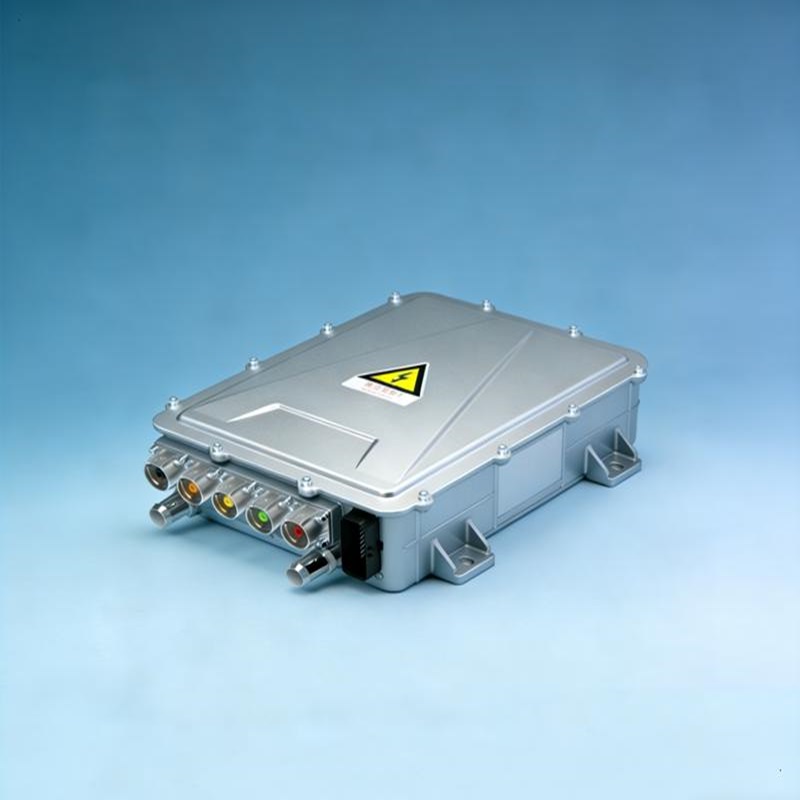
Why Does the AC Electric Motor Controller Matter Most for EV Performance?
Mar 26, 2026
When engineers and vehicle manufacturers evaluate electric vehicle powertrains, much of the attention naturally goes to the motor and battery. However, in real-world development programs, the component that ultimately determines whether a vehicle feels responsive, efficient, and reliable is often the least visible: the ac electric motor controller.
Real-World Demands and the Need for Precision
Consider a typical use case: an electric utility vehicle operating in an urban environment. These types of vehicles often encounter situations such as traffic congestion, frequent lane changes and sudden acceleration, as well as long periods of low-speed driving in narrow areas. If the control is not precise enough, the driver will clearly feel the abrupt acceleration, poor energy recovery during deceleration, and unstable torque output. Under these complex conditions, the motor itself is usually not the weak point; what really matters is the controller, which can convert the driver's operation into smooth and timely power output.
Speed Control Affects Daily Operations
In practice, the controller acts as the central interpreter between the battery, the driver’s inputs, and the motor. It continuously adjusts voltage, frequency, and phase current to match real-time demands. This is where ac electric motor speed control becomes essential. A well-designed controller enables seamless transitions from zero-speed torque to high-speed cruising, maintaining stability even under variable loads. For example, in a light commercial EV carrying payloads up steep grades, the controller must regulate speed without overheating or introducing vibration.Field experience has shown that vehicles equipped with high-performance controllers outperform those with basic performance in terms of acceleration performance, regenerative braking efficiency, and system pressure.
Flexibility Across Vehicle Platforms
Another critical real-world factor is flexibility. Manufacturers often develop vehicle platforms that must accommodate different power levels, voltage architectures, and auxiliary systems. A single vehicle model might need to support both low-power urban delivery versions and high-performance variants. In such scenarios, the use of an AC electric motor with speed control that features system-level speed regulation enables the same basic hardware to be adapted for various configurations, eliminating the need to redesign the entire power system. This approach reduces development risks and shortens the product launch cycle, making it a crucial priority choice for vehicle manufacturers with tight launch schedules.
Ultimately, the motor determines the performance limit of the vehicle, while the controller is the key factor that determines whether this performance can be safely, efficiently, and user-friendlyly implemented in practice. For engineers responsible for the electric drive system, the selection of the controller is no longer just a technical choice; it directly determines whether the overall vehicle performance is stable and reliable, whether it is suitable for actual road conditions and usage scenarios, and is a core component that affects the vehicle's performance.
Read More