Wisedrv bridges the gap between manufacturing capabilities and procurement needs, authoring in-depth technical articles, whitepaper analyses, and troubleshooting guides focused on cost control and lead time management. Need a custom solution? Contact Wisedrv directly.
Wisedrv | Senior Application Engineer & Industry Specialist
Many vehicle manufacturers, when developing micro vehicles, three-wheelers, golf carts, and electric platforms for construction machinery, prioritize the purchase of motors and controllers. However, without pairing them, they only discover matching issues during the bench test stage: sluggish torque response, abrupt regenerative braking feel, overheating under continuous load, and a calibration cycle far exceeding expectations.
The pairing of the motor and the controller is very crucial as they are important components of the vehicle. It is not simply a matter of comparing the parameters of the two specifications, but rather a system-level engineering effort that determines the reliability, operating efficiency, and overall driving experience of the entire powertrain. The following will outline the implementation ideas for the pairing.

1. Aligning the vehicle requirements with the power system
Any pairing of vehicle components must be based on the actual vehicle operating conditions, rather than simply looking at the component specifications in isolation. In the early stage of selection, engineers need to clearly define the vehicle category, peak load scenarios, and working environment. Golf carts mainly involve frequent starts and climbing slopes; engineering three-wheelers require continuous torque output under heavy loads, with many bumpy and dusty working areas.
The core information that needs to be confirmed at this stage is: maximum speed, climbing gradient, continuous working duration, battery SOC fluctuation range, and powertrain layout space. If the boundary conditions are not locked in advance, even if the hardware parameters seem to match, it will be difficult to meet the end-user requirements after installation. This is also the first aspect that OEMs evaluate when selecting an electric drive solution provider.
2. Matching voltage, current, and power range
After the vehicle's operating conditions are clearly defined, the next step is to verify the rated voltage, continuous current, and peak current of the motor and controller. This is the basis for their collaborative operation. The battery voltage of a light electric vehicle will fluctuate significantly with the battery charge level, which requires that the working voltage range of the electronic control unit must match the characteristics of the motor. Therefore, a controller that supports wide voltage input is often a must-have.
The peak current capacity of the controller must be able to support the peak torque required by the motor during vehicle starting and climbing, but excessive current redundancy will increase the cost of the electronic control hardware and bring additional conduction losses, reducing the overall assembly efficiency. Therefore, during the pairing verification process, both continuous operation and peak operation matching relationships need to be considered simultaneously.
3. Coordinated control strategy
Completing the hardware parameter pairing is only the foundation. To fully release the performance of the assembly and ensure stable operation of the vehicle, it is also necessary to achieve coordinated pairing of the motor and controller in the control strategy level.
Permanent magnet synchronous motor systems require customized adjustments based on the unique electromagnetic characteristics of the motor. If a general control program is directly installed on a high-power-density flat-wire motor, it is very likely to cause assembly efficiency decline, increased vibration and noise, and torque output fluctuations in the matching mismatch.
4. Stable heat dissipation management and operating efficiency
The cooling method of the motor and controller determines the continuous output capacity and long-term reliability of the powertrain.
Even if the parameters of the motor and controller are matched well individually, if the heat generation characteristics of the two under the vehicle's operating conditions are not jointly evaluated, the heat cannot be promptly dissipated, and the motor magnets, windings, and electronic control power components will experience performance degradation as the temperature rises, disrupting the originally calibrated torque and efficiency matching relationship.
Taking natural air cooling as an example, in the pairing stage of the motor and controller, sufficient windward space must be reserved, and the installation orientation of the vehicle must also be considered. During the scheme evaluation stage, it is necessary to simultaneously obtain the temperature rise test data of the motor and the electronic control unit under rated conditions and continuous overload. This coordinated thermal control can protect the insulation layer of the windings and the power devices, extend the service life of the entire electric drive system, and ensure that the electric drive system assembly can operate stably for a long time.
5. Case Study: 96V Flat Wire PMSM + Electronic Control Integrated Assembly Solution
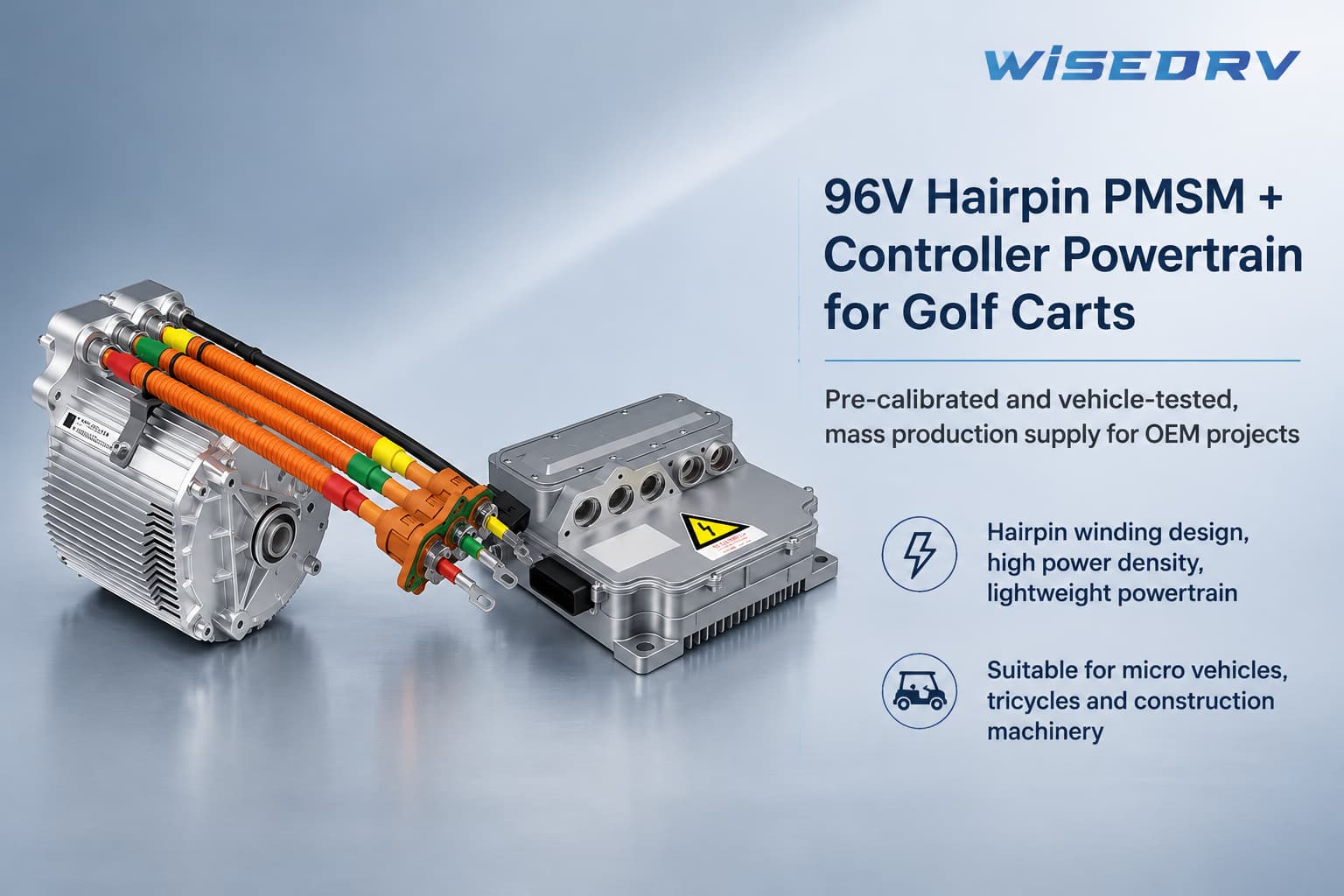
Based on the aforementioned matching strategy, we have completed the pairing research and engineering testing of a drive system for the 96V micro vehicle pure electric platform. This solution has been maturely implemented and is ready for OEM projects to supply in batches. The entire solution has completed the pairing of the motor and the electronic control unit before leaving the factory, effectively avoiding a series of problems caused by mismatch between the motor and the electronic control unit from the source.
This WISE permanent magnet motor drive system is equipped with an ABZ encoder to achieve high-precision rotor position feedback. It has a rated voltage of 96Vdc and a working voltage range of 60–108Vdc, suitable for applications such as golf carts, low-end micro vehicles, and light three-wheelers.
Core advantage
- Flat-wire winding design, high power density, achieving lightweighting of the powertrain
- Built-in VCU vehicle-level logic, active damping, and multi-level fault protection
- 60–108Vdc wide voltage operating range, suitable for all working conditions
- Standardized UDS diagnosis + OTA remote upgrade
- Natural air-cooling structure, IP67 protection level, compact structure, flexible vehicle layout
| Item |
Parameter |
| Product Type |
Hairpin PMSM + Controller |
| Rated Voltage |
96Vdc |
| Operating Voltage Range |
60 – 108Vdc |
| Rated / Peak Torque |
18Nm / 65Nm |
| Rated / Peak Speed |
3500rpm / 7500rpm |
| Cooling Method |
Natural Air Cooling |
| Position Sensor |
ABZ Encoder |
| Communication Protocol |
CAN2.0 |
| Upgrade Method |
OTA Remote Upgrade |
| Protection Class |
IP67 |
| Application Scenarios |
Microcars, Tricycles, Golf Carts, Construction Machinery |
6. Verification of Closed Loop: Platform Calibration and Vehicle Integration Testing
What truly determines whether the vehicle is compatible with the electric drive power system is not just the parameter data in the documents, but rather it requires the testing procedures of platform calibration and vehicle integration testing.
| Verification Stage |
Pass Criteria |
| Efficiency Calibration |
Efficiency meets design targets across all operating conditions |
| Protection & Diagnostic Test |
No false triggering; DTCs can be read normally |
| Vehicle Integration & Joint Commissioning |
Smooth regenerative braking and stable low-speed operation |
| Environmental Durability Test |
Temperature is kept within limits under continuous load |
| Aging Test |
No obvious function degradation and no hardware damage after long-cycle aging |
| Vehicle Integration & Joint Commissioning |
Smooth regenerative braking and stable low-speed operation |
Only when the powertrain passes through this closed-loop verification process and is successfully paired, can it meet the conditions for mass production.
7. WISE: Electric Drive Unit Supplier China
To find a complete motor and controller assembly system that is truly suitable for the entire vehicle, a significant amount of effort is often required in the procurement stage, and a long evaluation period is usually involved. If you are developing micro vehicles, golf carts, three-wheelers, or light construction machinery projects, you might want to take a look at WISE's advanced PMSM drive solutions: This set of equipment has undergone pre-calibration and real vehicle verification, and the complete assembly products have been batch-matched with vehicle manufacturers' projects.
If your current vehicle project is in need of a suitable PMSM motor drive system, please feel free to contact us. We will provide one-on-one selection matching suggestions based on your project requirements, and we can arrange sample tests.